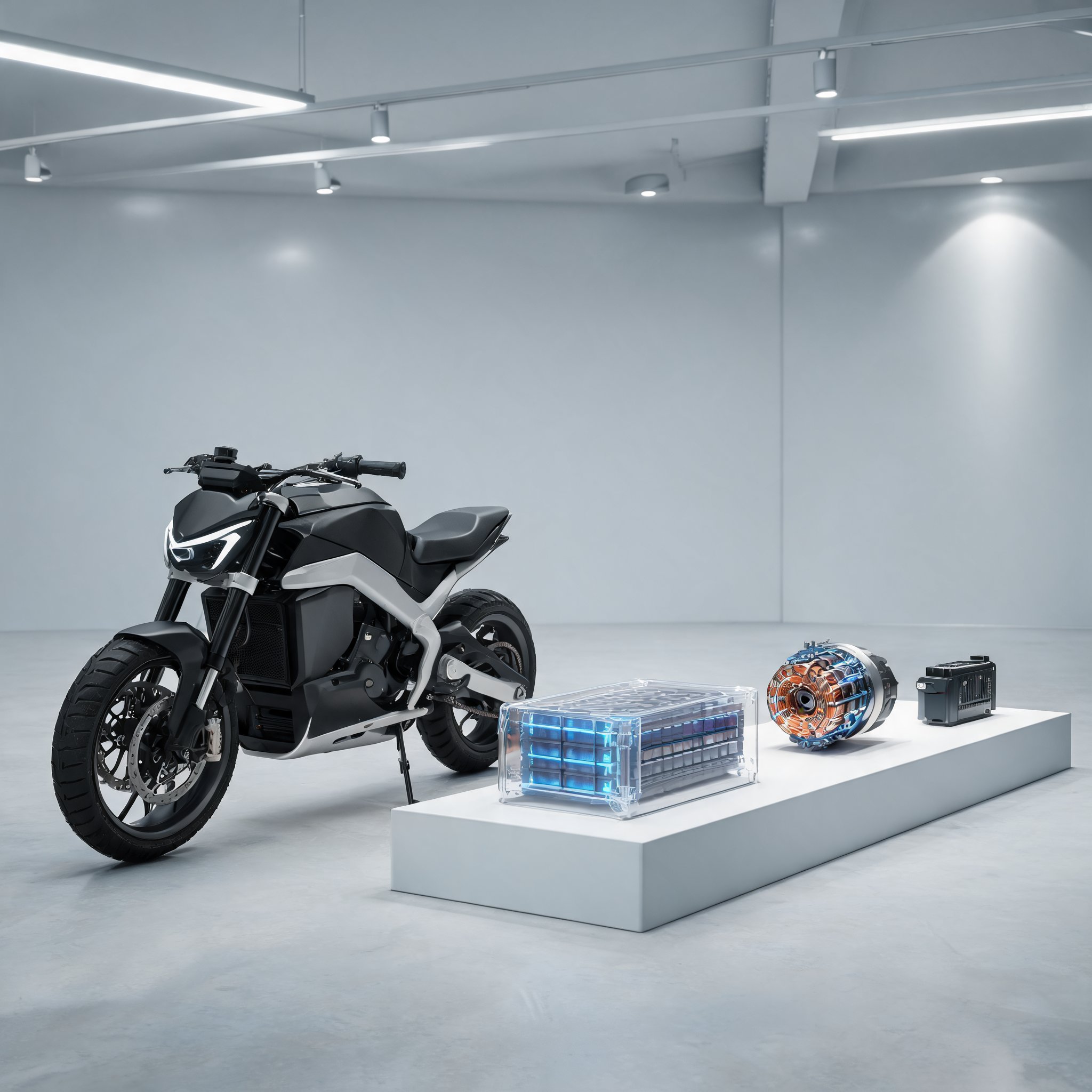
Indian electric two-wheeler manufacturer Ultraviolette Automotive has introduced a 100-volt electrical architecture called VX-100 and launched the X-47 Venom crossover motorcycle as its first application.
The company says the platform's three core elements are the SRB-11 battery pack, the Light Fury motor and a new motor controller, all developed in-house. The 11 kWh SRB-11 is described as the largest battery pack used in an Indian two-wheeler. Compared with the SRB10 pack in the original X-47, Ultraviolette says it has 25 per cent higher energy density, cools twice as fast, is 15 per cent lighter and supports charging twice as quickly. The company also claims it is the only electric two-wheeler battery pack in India to support DC charging at up to 12 kW.
The Light Fury motor uses an aviation-derived design, soft magnetic composites and a trapezoidal coil topology, and can spin at up to 9,000 rpm. It is 25 per cent lighter than the previous-generation unit and has twice the power density, according to Ultraviolette. The new controller uses silicon carbide power transistors, weighs 2.5 kg, is 40 per cent lighter than its predecessor and delivers three times the power density.
The X-47 Venom comes in standard, plus, Recon and Recon+ variants. Standard and plus models use a 7.5 kWh battery, while Recon and Recon+ versions use the 11 kWh pack with charging up to 12 kW. IDC range is 227 km and 343 km respectively. The plus and Recon+ add a 1.6 kW on-board charger. A standard 30 kW motor gives the motorcycle a 0-100 kph time of 5.9 seconds and a top speed of 155 kph; Ultraviolette calls it the quickest Indian-made motorcycle on the market.
Equipment includes cruise control, an IP67-rated 7-inch touchscreen with navigation, a 35-watt USB Type-C port, a rear-camera parking assistant and front and rear dashcams. A 77 GHz long-range rear radar provides blind spot monitoring, lane change assist, overtake alert and rear collision warning.
The base X-47 Venom is priced at 300,000 rupees, or about €2,800. A launch promotion offers a 35,000-rupee discount, about €330, to the first 5,000 customers, lowering the starting price to 265,000 rupees, or about €2,500. Ultraviolette has 55 showrooms in India and plans to reach 100 outlets by the first quarter of 2027.
In Europe, where Ultraviolette operates in 20 countries, the company plans to present the new model at EICMA 2026 on 3 November. CTO and co-founder Niraj Rajmohan said in an interview that deliveries are due to begin in early 2027. Ultraviolette has so far offered only the F77 there and has delivered about 500 to 700 units since sales began in July-August 2025.
The F-77 and X-47 are built in Bengaluru at a factory with capacity for 30,000 units, expandable to 50,000 to 60,000. A new 250,000-unit BIGGA plant in Hosur, Tamil Nadu, will have room to double capacity to 500,000 units. Rajmohan said the site will produce the Tesseract premium scooter and Shockwave enduro motorcycle, both using VX-100, and that Ultraviolette is working to bring these models to Europe.
Asked about a fully faired electric motorcycle, Rajmohan did not give a timeline but indicated that plans for the F99 would be announced after the Tesseract launch, scheduled for the first quarter of 2027. The F99 is described as a fully faired high-performance model with a 400-volt architecture, a 90 kW motor and 200 Nm of torque. It weighs 180 kg, the same as an X-47 Venom with the 7.5 kWh pack, and is claimed to reach 100 kph in three seconds and a top speed of 265 kph, estimated. Production specifications may differ.