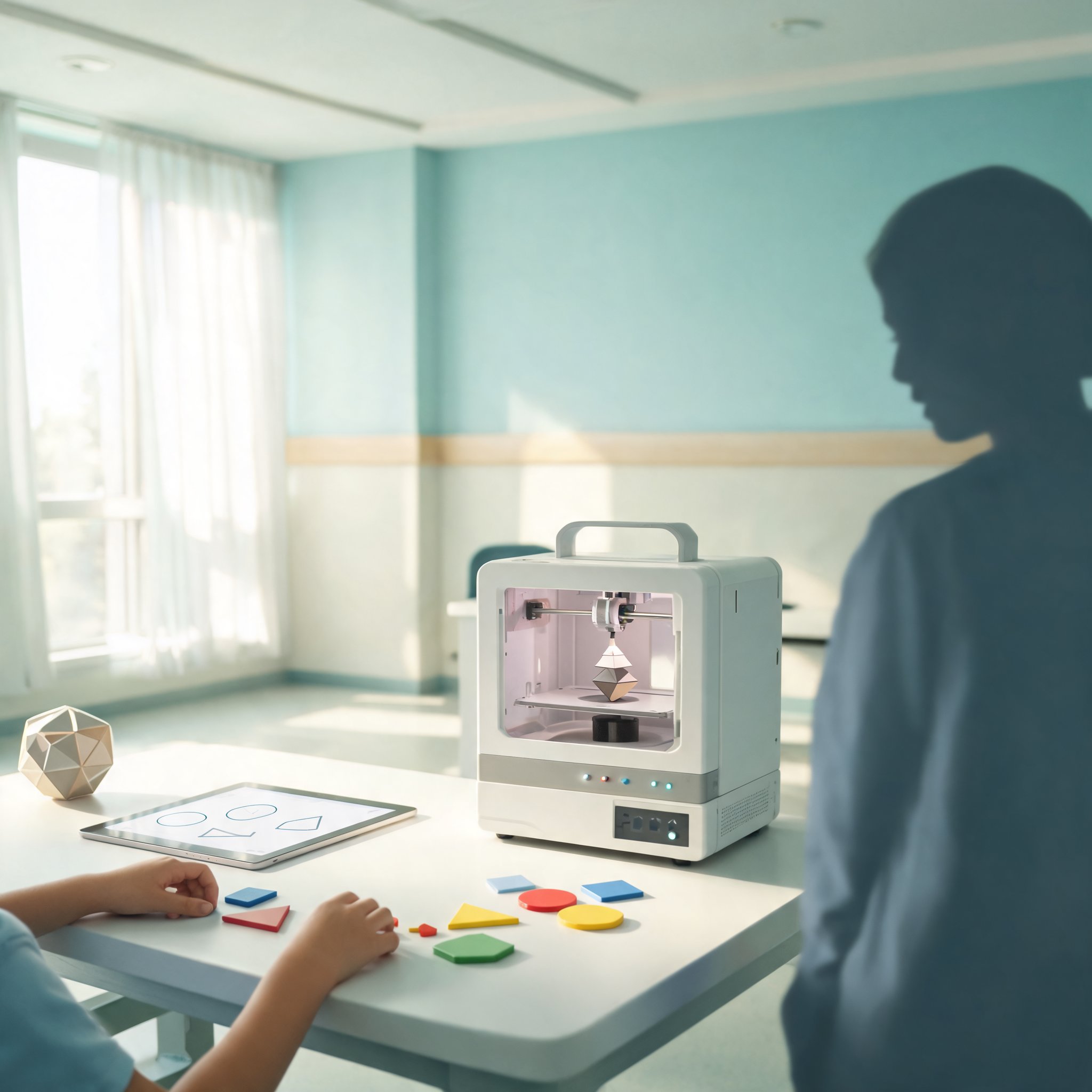
The University of Nottingham is leading a three-year project to introduce 3D design and printing to children and young people receiving education in hospitals and specialist schools in England.
The work has been funded by a Royal Society Science Community Grant and the Julia Rausing Trust. It is intended to widen access to STEM learning for students whose complex health needs or extended hospital stays keep them out of mainstream classrooms. The National Association for Hospital Education (NAHE) is collaborating on the programme, and engineers and scientists from universities around the country are supporting the training.
Printers and training for an initial 25 schools
An initial group of 25 schools will receive a 3D printer and take part in a national training programme led by Nottingham with help from local partner universities. The programme is scheduled to run over a school term through coordinated sessions focused on user-centred design, ending with a showcase event.
Students will be asked to draw inspiration from their surroundings and identify product designs that could work better for them. The practical work is meant to give participants experience of designing, testing and producing tangible objects rather than only studying STEM subjects in theory.
Why hospital education settings are the focus
Professor Ruth Goodridge, who leads the project at Nottingham, said children and young people who spend long periods in hospital or attend specialist schools because of complex health needs often miss hands-on STEM opportunities that other students take for granted. She said the programme is intended to help close that gap by offering 3D design and printing activities that can broaden horizons, build confidence and develop useful skills.
Goodridge also noted that hospital school staff report that illness can make a child's world feel small, with disrupted education, anxiety and low confidence affecting engagement. In that context, 3D printing offers an accessible way for students to solve problems and create something tangible, she said, providing a sense of achievement when many parts of their lives may feel outside their control.
Sir Paul Nurse, President of the Royal Society, said schools are where most people first encounter science and that practical science helps students experience the scientific process, assess evidence, understand uncertainty and see how science helps explain and improve the world. He said embedding more practical science in schools is important for building future scientists and innovators and for equipping people with scientific literacy.
Rehabilitation research link
The NIHR HealthTech Research Centre for Rehabilitation, led by Nottingham University Hospitals NHS Trust, is partnering with the project. It will explore how 3D printing technologies might contribute to children's rehabilitation and recovery after serious illness or injury. This is a research question rather than a reported clinical outcome.
Stephen Deadman of NAHE said the project will provide vital skills for children who cannot access traditional school and give them hands-on experience with specialist equipment. He added that working together within and between schools should bring a sense of community and shared achievement alongside individual skill development.
The project's initial scope is limited to 25 schools and a term-long programme, with the longer-term reach and rehabilitation applications still to be determined through delivery and research.