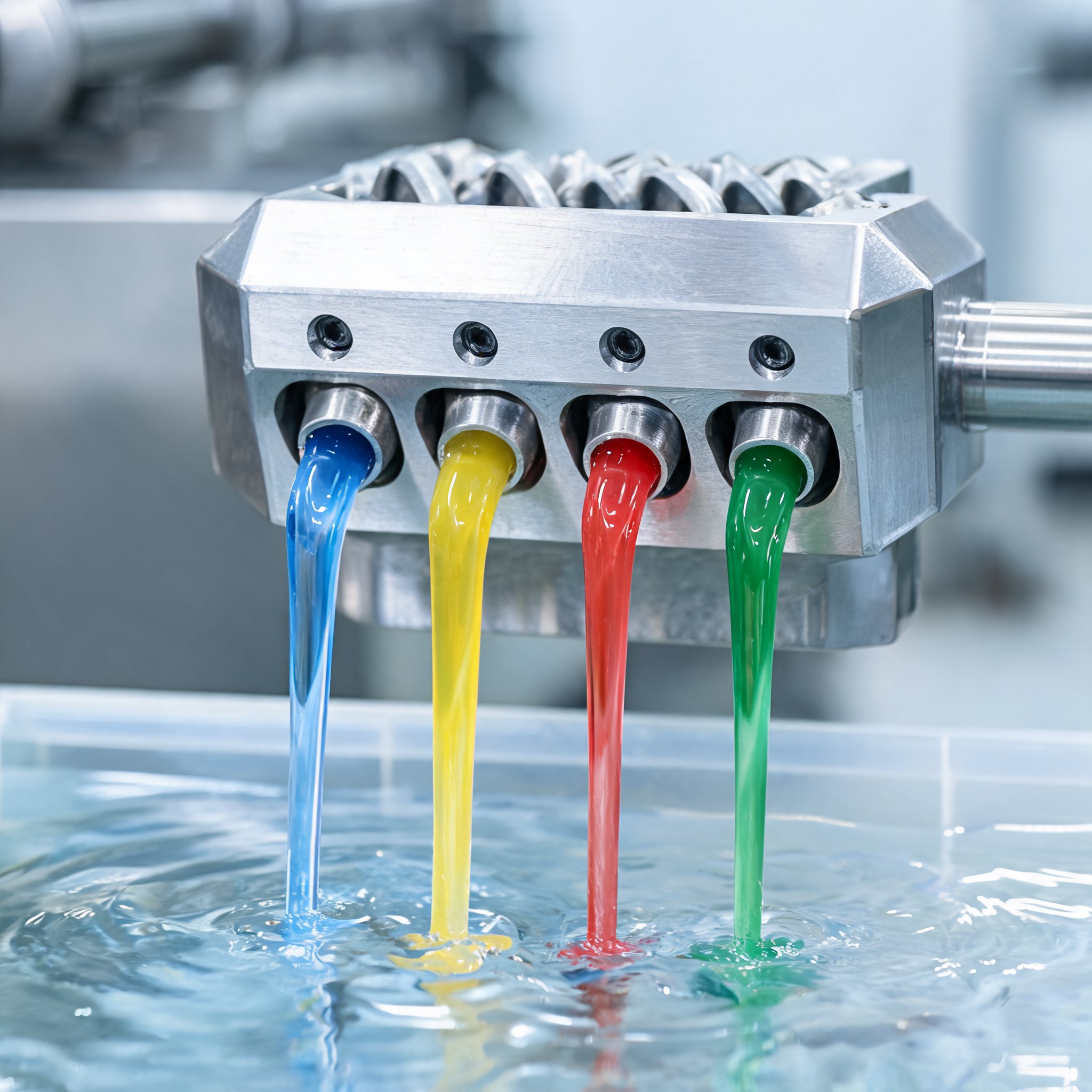
A study of four commercial natural colorants — blue spirulina, yellow curcumin, red beetroot and green chlorophyllin — has found that most can be compounded into polylactic acid (PLA) and polybutylene succinate (PBS) on conventional twin-screw extrusion equipment, with only modest effects on melt flow and mechanical performance. The exception was spirulina in PLA, which lost its blue color at the polymer's processing temperature. Photostability, rather than heat or mechanics, emerged as the main obstacle to wider use.
The work, published under the title "Sustainability in the Development of Natural Pigment-Based Colour Masterbatches and Their Application in Biopolymers," was driven by a familiar conflict: color is essential to how plastic products look and perform in the market, but conventional pigments sit awkwardly with biodegradability and low-carbon objectives. If natural colorants are to replace them, they must survive melt processing, hold their shade, and avoid degrading the properties of the polymer that carries them.
How the masterbatches were made
Each pigment was compounded with PLA and with PBS on a twin-screw extruder to produce color masterbatches. The formulation also contained titanium dioxide, calcium carbonate and stearic acid, added for UV protection, dispersion and processing support respectively. The masterbatches were then diluted into the matching polymer at 2, 4 and 6 wt% and injection molded into test specimens, so that color retention, rheology and mechanical behavior could be assessed at realistic addition levels rather than in pure pigment form.
Thermal margin defines compatibility
Heat is the binding constraint. Natural colorants are organic structures and begin to break down at temperatures below those at which PLA and PBS are normally melt-processed. Thermogravimetric analysis put the degradation onset at roughly 229 °C for spirulina, 244 °C for curcumin, 258 °C for chlorophyllin and 267 °C for beetroot — all well under the degradation temperatures of the two polymers.
That margin allowed the researchers to design temperature profiles that melted each polymer while limiting the pigments' thermal exposure: 145 °C for PBS and 190 °C for PLA, with the extruder running at 65 rpm and a feed rate of 2 kg/h. Most pigment–polymer pairings came through this window intact. Spirulina did not. Processed in PLA at 190 °C, it lost its characteristic blue, and a blue PLA masterbatch could not be produced; in PBS, the lower processing temperature preserved enough pigment stability for successful compounding. The practical lesson is that a natural colorant's suitability cannot be judged on its own — it depends on the thermal profile the matrix demands.
Flow and mechanical performance hold
From a processing standpoint the pigments were well behaved. Melt flow rate fell only slightly after incorporation, indicating a modest rise in melt viscosity. Neat PLA measured about 50 g/10 min, and the natural-pigment masterbatches stayed close to that figure; PBS responded in similar fashion. For compounders this matters more than it might appear: a color system that forced changes to screw design, pressure settings or molding conditions would carry limited practical value, whereas these formulations ran on standard twin-screw compounding and injection molding without major problems.
Mechanical testing covered the full 2 to 6 wt% range. Neither polymer showed significant overall losses. PLA started from a Young's modulus of about 1710 MPa and tensile strength of 65.6 MPa; PBS from about 392 MPa and 34.5 MPa. The colored formulations remained close to those baselines, and impact strength stayed within a comparable range, although individual pigments produced some variation.
Light exposure is the limiting factor
Successful extrusion did not translate into durable color. After 50 hours under a xenon lamp, most formulations showed a color difference above ΔE* = 2 — the threshold at which a change is generally visible to the eye. The one clear exception was a PLA formulation carrying 2 wt% chlorophyllin masterbatch, which showed the highest photostability in the set. The study therefore points to UV stability as the largest barrier to broader adoption. Packaging, consumer products, agricultural parts and outdoor applications would likely need additional stabilization, protective coatings or pigment modification before natural colors could match conventional systems over long service periods.
A carbon footprint advantage
The environmental comparison ran in the opposite direction from the durability results. Under the study's assumptions, one kilogram of curcumin pigment was associated with about 0.04 kg CO2-eq, against 18.65 kg CO2-eq for the inorganic green reference pigment. The natural-pigment masterbatches also consumed less electricity during extrusion and pelletizing. These figures depend on the study's stated assumptions and are best read as indicative rather than as a general life-cycle verdict; they do, however, show where part of the appeal of natural colorants lies.
What remains to be solved
The study's conclusion is measured rather than promotional: several natural colorants can be compounded into PLA and PBS using conventional equipment, with limited changes in melt viscosity and mechanical performance, but masterbatches still require development in lightfastness and thermal stability. Improving color retention both during processing and during subsequent service exposure is the stated priority. Until that gap narrows, natural pigments appear best suited to applications with modest light exposure or shorter service lives, with outdoor and long-life products remaining the harder test.