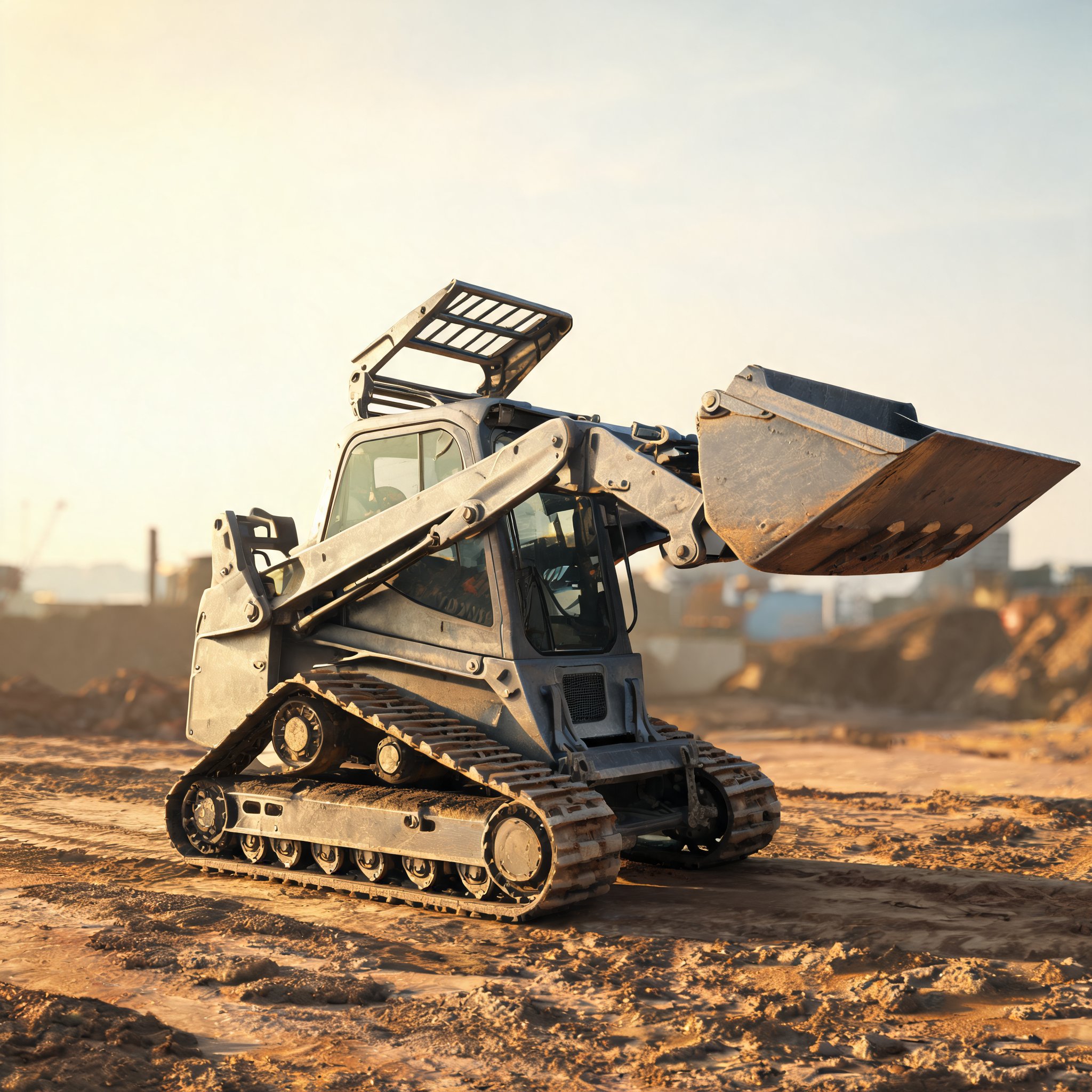
Caterpillar has expanded its compact track loader line with the Cat 253, a machine positioned between the Cat 249D3 and the 255 and designed for grading and material handling. The loader offers a 2,006-pound (910-kilogram) rated operating capacity and an operating weight of 9,343 pounds (4,238 kilograms), figures the company says support easier transport between job sites.
Built on the Cat 259D3 foundation, the 253 integrates a next-generation one-piece undercarriage with rigid frame-mounted axles intended to support traction and stability when handling heavy loads. Four fully independent axles mount directly to the frame to enhance grading capability, while new 15-inch (380-millimeter) general-duty C-Pattern tracks are designed to increase ground engagement and deliver strong grip in mud and other soft underfoot conditions.
Caterpillar describes the track roller frame as a redesigned one-piece design similar to the one used on the 255, contributing to stability and operator confidence. The 255 and 253 track types are interchangeable, the company notes, giving customers more options.
Power and hydraulics
The 253 is powered by an electronically controlled Cat 3.3B engine that delivers high horsepower and torque while meeting U.S. EPA Tier 4 Final and EU Stage V emissions standards. Hydraulic output differs by configuration: standard-flow models provide 20 gpm at 3,336 psi (76 lpm at 23,000 kPa), while high-flow cab models deliver 30 gpm at 3,336 psi (112 lpm at 23,000 kPa). Higher travel speeds are achieved through a two-speed transmission.
Operator comfort and control
Two configurations are available, a canopy and a sealed, pressurized cab, to meet customer preference. A standard high-back, heated air-ride seat with adjustable joystick pods is intended to provide all-day operator comfort. Operators can switch joystick command patterns between ISO and H patterns to suit their preference, and a full-color, 5-inch (127-millimeter) LCD screen with soft-touch buttons provides operating control.
Service access was also considered in the design. A tilt-up, one-piece cab provides quick access to under-cab components, and ground-level access to daily service and routine maintenance points is intended to help improve productivity.
Technology and attachments
- Standard dual self-levelling automatically keeps attachments and material level when raising and lowering, for better stability and material retention.
- A return-to-dig and work tool positioner automates repetitive tasks to increase operating efficiency.
- Creep speed technology helps prevent overspeeding to achieve a smooth, precise finish in applications such as cold planing or fine grading.
Caterpillar says its connected-worksite technology helps streamline equipment maintenance and advance efficiency and safety at the job site. Aftermarket customization is possible through purpose-built kits.
Positioning in the line
Zach Waite, commercial director for Caterpillar Industry Solutions, said each model in the 8,000- to 10,000-pound compact track loader class features a unique undercarriage design engineered to optimize performance across a wide range of applications, and that adding the 253 gives customers another solution for meeting their toughest challenges.
"Combining our one-piece next-generation undercarriage with independent rigid, frame-mounted axles gives customers a system that helps to deliver a stable platform when lifting and grading," Waite said. He added that the 253 fits well between the Cat 249D3 and 255, and that the C-Pattern track design gives customers a productive all-around machine able to perform on gravel, dirt, hard surfaces, turf, snow and unfinished terrain.