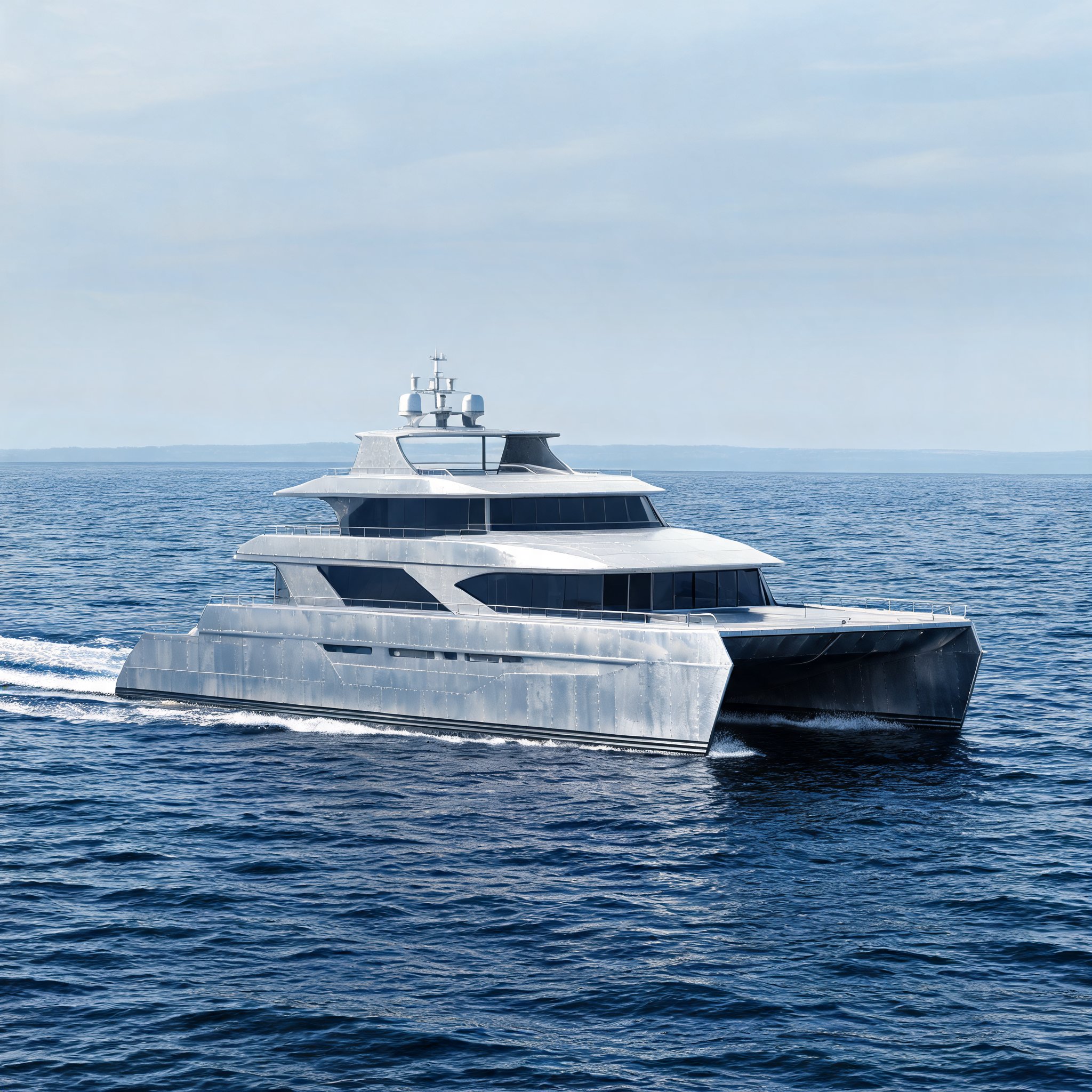
Bering Yachts has presented the first hull of its BC60, an aluminium explorer catamaran that marks the shipyard's move to a twin-hull platform while keeping the long-range capability and structural robustness of its existing explorer line. The 18.9-metre vessel has already been delivered and is afloat, and founder and chief executive Alexei Mikhailov gave a detailed walkthrough of its design and onboard systems.
Dimensions and long-range capability
The BC60 measures 18.9 metres (60 feet) overall with an 8.6-metre beam and is conceived as a displacement explorer rather than a high-speed production catamaran. Draft is 1.58 metres, fuel capacity exceeds 13,500 litres, and the yard quotes a range of more than 3,500 nautical miles at a cruising speed of 8 knots. Fresh-water capacity is about three cubic metres, while the grey-water and black-water tanks hold 1,500 litres each. All-aluminium construction, the shallow draft and the fuel volume are intended to support extended passages and greater autonomy at sea.
Mikhailov said the yard had taken the characteristics already proven on its B72 and B88 models — range, reliability, quiet running and the ability to remain self-sufficient for long periods — and applied them to a catamaran platform. He described the BC60 not as a leisure catamaran but as a displacement exploration machine.
Aluminium construction and engine-room layout
The BC60 applies Bering's explorer philosophy to a twin-hull configuration, with a layout arranged around the equipment and storage that long journeys demand. Unusually deep sponsons house a two-level engine-room arrangement, giving accessible space for generators, watermakers, sewage-treatment equipment and other onboard systems, and the arrangement also helps isolate noise and vibration from the living areas. Protected running gear and attention to structural integrity reflect a safety-oriented approach, while the aluminium construction and the resulting weight distribution allow a fully enclosed flybridge that works as a second salon.
Accommodation and the enclosed flybridge
The main deck carries a spacious salon with a full helm station offering 360-degree visibility, and a professional galley is arranged on both sides of the space for practical use on board. One hull chamber holds the master room, which has space to walk around the bed, panoramic windows, a walk-in wardrobe and an en-suite bathroom with a full shower. The opposite sponson contains two guest cabins, each with its own bathroom. A dedicated crew cabin, laundry and pantry areas, additional refrigeration capacity and extensive storage are also included, so the catamaran can support long stays whether it is owner-operated or run by a small professional crew.
Above, the enclosed flybridge adds a bar, refrigeration, a day bathroom and 360-degree visibility, and can be configured as a lounge, gym or office. Mikhailov highlighted low sound and vibration levels at cruising speed alongside the storage capacity and onboard systems intended to support self-sufficiency on long passages.
The delivery and launch of the first hull mark the practical realisation of Bering Yachts' twin-hull explorer concept, extending design principles established in the B72 and B88 to a new vessel format that combines the requirements of a long-range explorer with the additional space offered by a catamaran platform.