Bambu is releasing details of its forthcoming H3C 3D printer one feature at a time, and the latest teaser moves from color to nozzles and filament types.
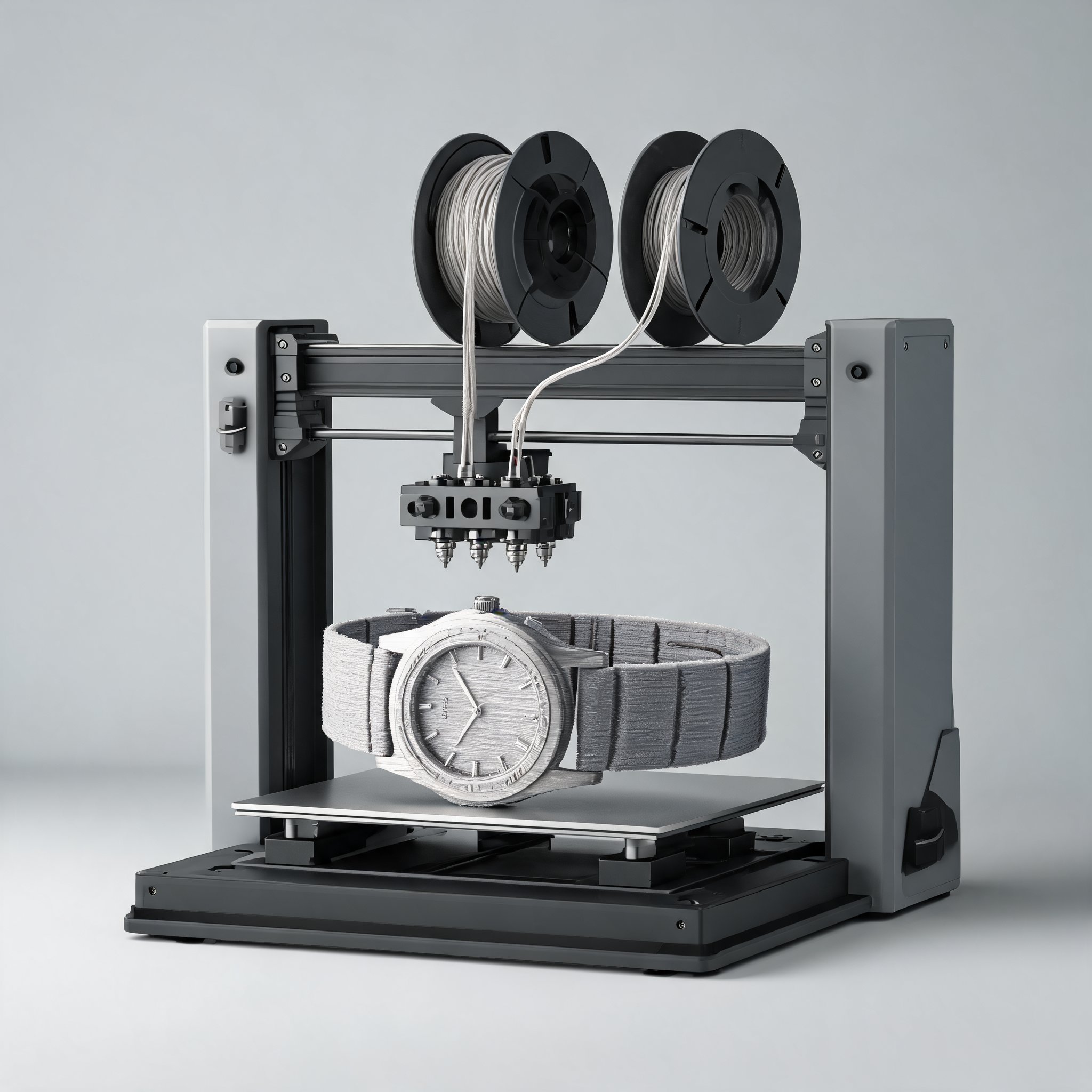
After an earlier hint at multi-color output, the company showed an image of a multi-component watch in which each part is assigned a different nozzle and filament combination:
- a 0.4 mm nozzle running 1.75 mm filament for the rigid case;
- a 0.2 mm nozzle running 1.75 mm filament for crisp details;
- a 0.4 mm nozzle running 2.85 mm filament for the soft strap, which the source suggests may be TPU.
The teaser points to two developments. First, Bambu appears to be adding 2.85 mm filament compatibility for soft, rubbery materials such as TPU. Second, and more significantly, it implies that 0.2 mm and 0.4 mm nozzles can be used within the same print.
Single-nozzle limit on current machines
That capability has been a long-standing request from owners of Bambu's H2D and H2C printers, and likely the newer X2D as well. On existing machines, users reportedly cannot mix 0.4 mm and 0.2 mm nozzles in one job; only a single nozzle can be selected. The implication is that multiple nozzle and filament sizes could be combined in one job, presumably when several objects are printed together, although software limits are said to stand in the way on the current dual-nozzle models.
It is not yet clear whether mixed nozzle sizes would come to all compatible Bambu printers or only to the upcoming H3C and the smaller P3C, which has not been formally announced. The answer may depend on whether Bambu prioritizes sales of the new machines or adds features to installed ones.
An update to the source report says a teaser video shows watch components printed in place as a single part using multiple nozzle and filament sizes.