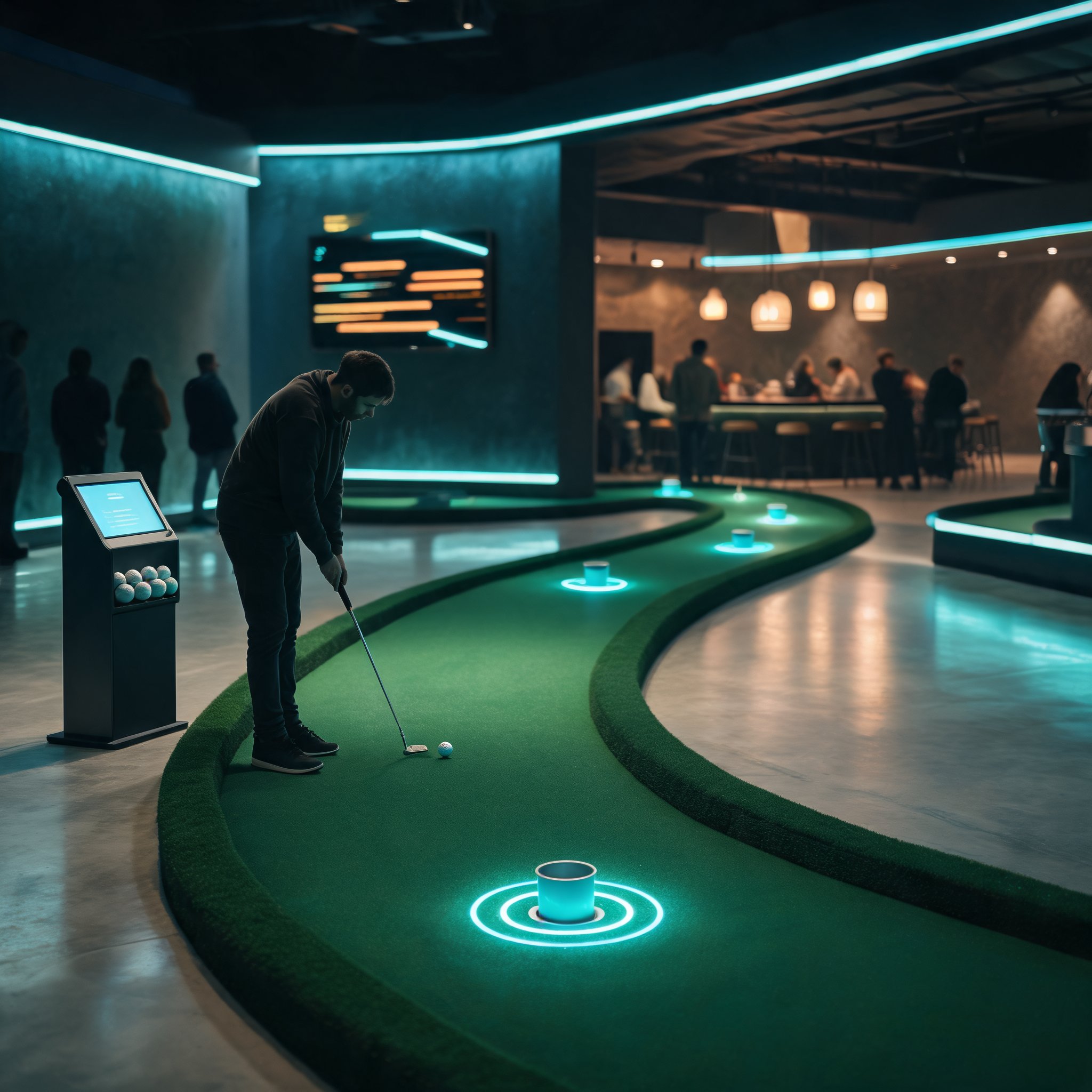
360Golf, a Holovis brand, is trying to move mini golf from a standalone leisure amenity into a connected operating platform. The proposition combines a familiar putting game with automated scoring, gamified challenges and an analytics layer that gives operators a view of how players use the course. Rather than replacing mini golf with a new format, 360Golf builds on the game’s existing accessibility and adds technology that is meant to be easy for guests to pick up and hard for operators to ignore.
The product’s base layer is automated scoring. Smart balls, tees and cups work with Holovis’ HoloTrac system to remove paper scorecards and to act as a referee when groups compete. On top of that, 360Golf layers SuperShots, Triumphs, bonus points, on-course games, player accounts, achievements, leaderboards and video celebrations. These features are designed to give players reasons to compete, compare results and return. The company’s executives describe the appeal as more interactive and more measurable than traditional mini golf, while retaining a format that most visitors already understand.
A platform, not just a course
The distinction matters for competitive socialising venues. A course can be copied through theming and layout; a platform becomes more valuable when scoring, player accounts and analytics are consistent across locations. 360Golf is positioning itself around that consistency. Its installations span the UK, Europe, the Middle East, North America and Asia Pacific, and the company says the system can support multi-site operators such as Saudi Entertainment Ventures (SEVEN) by keeping core technology consistent while allowing theming, layout and branding to vary.
For operators, the commercial logic is tied to throughput and secondary spending. 360Golf says the system can optimise capacity to up to 80 people per hour per course. At Butlin’s Bognor Regis resort, where the £15m PLAYXPERIENCE indoor activity centre opened in 2024, the company reports that the tech-putt offer has reached 5,000 players in a busy week and grossed around £40,000 in weekly revenue. Those figures are company-reported and specific to one venue, but they illustrate the operating model 360Golf is selling: quick guest onboarding at kiosks, automated scoring during play, and staff freed to manage food, drink and guest service.
Data as an operating layer
The analytics engine, DeepSmarts, is central to that model. 360Golf says it gives operators insight into player behavior, seasonality, uptime and operational bottlenecks, and can support promotions aimed at quieter periods or underserved groups. The same data can help Holovis shape product development. Maintenance is also part of the pitch: the system is designed for venue-level repair, and DeepSmarts can help engineers diagnose problems remotely by reviewing what happened on course.
This is where the platform argument becomes more credible than a simple scoring upgrade. Automated scoring creates a data stream; the data stream supports operations, marketing and product decisions; and those decisions can feed back into repeat play. The loop is not automatic, and the available figures are company-reported and venue-specific, so they illustrate the model rather than prove it across the portfolio. But it explains why 360Golf is being presented as an operating system for competitive socialising rather than a themed mini-golf kit.
Flexibility across venue types
360Golf’s design options are deliberately broad. Operators can retrofit technology into an existing mini-golf attraction, choose from catalogue holes, or commission a fully custom course. The company says tech-only deployments take about six to eight weeks, catalogue installations can be ready in eight to 12 weeks, and custom courses can take six months or more. That range matters because competitive socialising operators are not all working with the same footprint, budget or audience.
The examples show how far the format can stretch. Super Social in Leopardstown, Ireland, uses 12 holes from a 360Golf sports-themed package. Norwegian Cruise Line’s Tee Time installations use marine-grade, waterproof equipment and IP-rated technology for use at sea. Netflix House’s Top 9 course is a fully custom, IP-led installation with unique holes and interactive elements. At Lucky Duck in Norway, a custom course offers two routes for each hole. Each project changes the physical design while keeping the 360Golf scoring and gameplay layer as the common thread.
Inclusive design and repeat play
The Butlin’s project also highlights inclusive design. The Bognor Regis site includes three nine-hole 360Golf courses: a neon-glow course, a Las Vegas-themed challenge and a wheelchair-accessible music-themed course. 360Golf’s project manager, Maaz Ussen, says accessibility can involve right- and left-handed play, appropriate putter sizes, wheelchair access close to or onto the course, tees placed near the edge for reach, and enough spacing between holes to reduce crowding and safety hazards. These are practical design choices, not just branding claims, and they widen the addressable audience for a venue.
The gamification layer is meant to support the same goal. Player accounts, achievements, leaderboards and video celebrations give groups a reason to compare scores and come back. 360Golf’s business development director, Matt Dobbs, argues that this creates more reasons to compete, celebrate and revisit. The company’s global business development director, Stuart Edgington, adds that mini golf’s familiarity is an advantage because operators do not need to teach a new activity from scratch. That combination—familiar play, automatic scoring and layered challenges—is the core of the offer.
Boundaries and next markets
The model still depends on execution. Custom courses require close coordination between creative, software and engineering teams; marine and IP-led projects add their own constraints; and multi-site consistency depends on operators using the platform’s data and standards. 360Golf also faces a competitive socialising market that Edgington expects eventually to reach peak saturation. The company is therefore looking beyond mini golf, including an integration with Roxy Leisure to add stroke-counting technology to crazy pool tables, and it sees potential to apply its technology to other sports.
For now, 360Golf is presenting a turnkey proposition: technology, course design, gamification, analytics and support. The company is due to exhibit at the Land Leisure & Tourism Show in Birmingham and at IAAPA Expo in Orlando, where it plans to offer demonstrations. The larger point is not that mini golf has become digital. It is that a familiar leisure format is being rebuilt as a measurable, repeatable platform—one that can be retrofitted, scaled across sites or customised for a cruise deck or an IP-led venue, provided operators buy into both the course and the operating model behind it.